Google Ads for Med Spas: A High-LTV Playbook
Med spa patients carry four- and five-figure lifetime value, which is why a higher cost-per-lead still pencils out on paid search. Here is the Owner's Math, the real 2026 benchmarks, and what to build before you spend.
Key takeaways
- The average U.S. med spa earned $1,398,833 in 2024. High lifetime value is why a $39.25 cost-per-lead on paid search still pencils out.
- Aesthetics is getting more efficient on Google Ads: Beauty & Personal Care had the biggest conversion-rate gain of any industry in 2026 (+32.34%) and a cost-per-lead well below the $66.69 all-industry average.
- Track calls, not just forms: 37% of phone leads convert on the call and roughly a third of digital-marketing calls are real sales leads.
- Reviews are part of ad performance: 97% of consumers read reviews and 41% always do, so reputation decides whether the click actually books.
- Run Owner's Math on the back half of the funnel (booking and rebooking), where the real return lives, not on shaving pennies off the click.
Why Google Ads for Med Spas Pencils Out
The economics start with one number. The average U.S. medical spa generated $1,398,833 in annual revenue in 2024, up from $1,307,587 the year before, which tells you the lifetime value behind a single new patient is large. When a client is worth four or five figures over the relationship, a higher cost to acquire that client can still pencil out. That is exactly why Google Ads for med spas works where a lower-ticket business would bleed.
Most owners get this backward. They chase the cheapest possible lead instead of asking the only question that matters: what does $1 of ad spend return once the lead books, shows, and rebuys? That is the Owner's Math discipline: trace the dollar from impression to revenue, not to a click. For aesthetics the math is forgiving, because the average lead is cheap relative to what a booked patient is worth over a year of treatments.
The Real Paid-Search Economics for Aesthetics
Here is what paid search actually costs in this category. For Beauty & Personal Care, the 2026 benchmarks were a $4.62 average cost-per-click, a 6.75% click-through rate, a 10.35% conversion rate, and a $39.25 average cost-per-lead (cost-per-lead = total spend divided by leads generated). Those are the real numbers to model a med spa budget against, not an agency's promises.
The trend is in your favor. Beauty & Personal Care posted the biggest year-over-year conversion-rate increase of any industry in 2026, up 32.34%, while its $39.25 cost-per-lead sits well below the $66.69 all-industry average. In plain terms: Google Ads for med spas is getting more efficient, not less. Before you commit a number, read How Much Should You Spend on Google Ads? so the budget matches your capacity to actually book the leads it produces.
Owner's Math for a Single Med Spa Lead
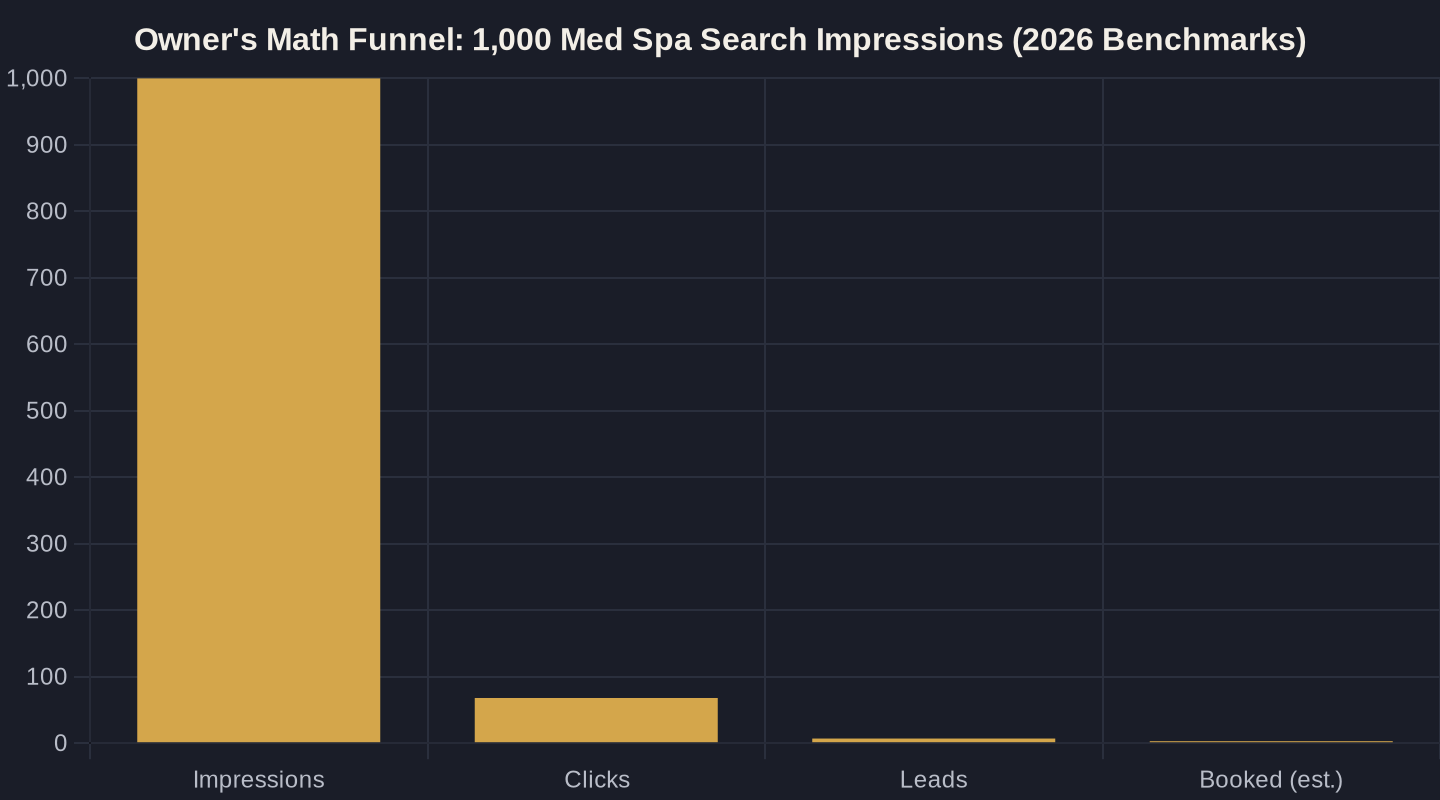
Run the funnel and Google Ads for med spas stops being abstract. Start with 1,000 ad impressions. At a 6.75% click-through rate you get about 68 clicks; at a 10.35% conversion rate those clicks produce roughly 7 leads. If your front desk and your reviews convert 40% of leads into booked consults, that is about 3 booked appointments out of 1,000 impressions.
Now attach dollars. At a $39.25 cost-per-lead, those 7 leads cost about $275. If one consult becomes a $1,500 to $3,000 client and one in three leads books, your return on ad spend (ROAS = revenue divided by ad spend) clears the bar fast. The chart below shows where the drop-off happens, and it makes the point most owners miss: the leverage is in the back half of the funnel, in booking and rebooking, not in shaving pennies off the click.
The Phone Is a Primary Conversion Path
For a high-consideration purchase like injectables or laser, people call before they commit. Across industries, 37% of phone leads convert during the call and 35% of calls from digital marketing are genuine sales leads, which makes the phone a primary conversion path for a med spa, not an afterthought. If your Google Ads setup only counts form fills, you are blind to a third or more of your real results.
Call tracking belongs in the build from day one. Without it you cannot tell which keywords drive the phone to ring, and you will cut the campaigns that are quietly booking your calendar. This is also where keyword choice earns its keep: the right terms get you the call, the wrong ones burn budget on tire-kickers. See Choosing (and Blocking) the Right Google Ads Keywords for Local for the map and the negatives.
| Metric | Beauty & Personal Care (2026) | Notes |
|---|---|---|
| Average cost-per-click (CPC) | $4.62 | What you pay for each click |
| Click-through rate (CTR) | 6.75% | Share of viewers who click your ad |
| Conversion rate | 10.35% | Up 32.34% YoY, biggest gain of any industry |
| Cost-per-lead (CPL) | $39.25 | vs $66.69 all-industry average |
Reviews Decide Whether the Click Books
The click is only half the battle; reputation closes the gap. 97% of consumers read online reviews for local businesses, and 41% now say they "always" read reviews, up from 29% the year before. A prospect clicks your ad, then opens a new tab and checks your star rating before they ever fill out the form or pick up the phone.
That means review reputation is part of your Google Ads performance, even though it lives outside the ad account. Two med spas can run identical campaigns; the one with 200 four- and five-star reviews will turn more of the same clicks into booked patients. Fix reviews and you lower your effective cost-per-lead without touching a single bid, which is the cheapest performance lever you have.
Competition Is Rising: Structure for Efficiency
Demand is climbing, and so is competition for the same patients. The global medical spa market was an estimated $25.28 billion in 2025 and is projected to reach roughly $97.91 billion by 2035, a 14.50% compound annual growth rate, with North America holding the largest share at 42%. More demand pulls more advertisers into the auction, which pushes clicks up over time. Today's $4.62 average cost-per-click will not stay there.
Efficiency is how you stay ahead of that curve. Tight geo-targeting, exact-match on your money services, and aggressive negative keywords keep you out of auctions you cannot win profitably. If you are still deciding where to put the first dollar, weigh Local Services Ads vs Google Ads, and read the full Google Ads for Local Service Businesses: The Complete Playbook for the campaign structure that sits underneath all of this.
Set This Up Before You Spend
Before you spend a dollar on Google Ads for med spas, get the foundation right. Four things separate the accounts that compound from the ones that leak:
- Call tracking and form tracking both wired to conversions, so the phone gets counted.
- A service-by-service keyword map with negatives blocking jobs, training, and DIY searches.
- Tight radius targeting around each location: patients drive to you, they do not cross the state.
- A review engine running, because reputation decides whether the click books.
Get those four right and the benchmarks above become a floor, not a ceiling. If you want a second set of eyes on your numbers (your real cost-per-booked-patient and where the spend is leaking), that is exactly the Owner's Math read I do on a call. Or join the newsletter for the same breakdowns, owner to owner, before you commit a budget.
Sources
- American Med Spa Association (AmSpa): 5 Things You Didn't Know About Medical Spas (2025)
- Precedence Research: Medical Spa Market Size (2025)
- LocaliQ: Search Advertising Benchmarks (2026 Data) (2026)
- WordStream: Google Ads Benchmarks 2026 (2026)
- BrightLocal: Local Consumer Review Survey 2026 (2026)
- Invoca: 5 Insights From Analyzing 60 Million Phone Conversations (2025)
Want this run on your numbers?
Book a call and we will run the Owner's Math on your business: clear numbers, a straight plan, no pitch. Or read the free Playbook first.