How Much Should You Spend on Google Ads? A Local Budget Guide
A plain-English way to size your Google Ads budget for local business, built on real 2025 click and lead costs and the only number that actually matters: what a booked job is worth to you.
Key takeaways
- There is no universal Google Ads budget. Your number falls out of what a booked job is worth and how many leads convert, not a percentage of revenue.
- Cross-industry, expect about $5.26 per click and $70.11 per lead in 2025; trades like plumbing and HVAC run roughly $128 to $129 per lead, so size the budget to your vertical.
- Most local businesses start at $1,000 to $2,500 per month ($20 to $50 a day) and scale only when cost per booked job holds.
- Calls are a primary conversion path in home services (37% of marketing calls are leads and 46% close on the phone), so call tracking belongs in the budget math.
- Set a number you can defend, then watch cost per booked job for 30 to 60 days before changing it.
Start With Owner's Math, Not a Generic Google Ads Budget for Local Business
The honest answer to "how much should I spend on Google Ads?" is not a dollar figure. It is a question back to you: what is a booked job or a new patient worth, and how many can you actually handle? Every number in this guide is a tool to answer that. A Google Ads budget for local business works when it is sized to your math, not to a competitor's spend or a figure an agency pulled from the air.
That math is what I call Owner's Math (tracing what $1 of marketing returns, from impression to lead to booked job to revenue). Most owners I talk to are spending blind because they never connected spend to a known cost per customer. The cross-industry averages of $5.26 per click and $70.11 per lead in 2025 give you a starting reference, but your real budget falls out of your own conversion rate and your own job value. For the full system this guide sits inside, start with the Google Ads for Local Service Businesses: The Complete Playbook.
What Clicks and Leads Actually Cost in 2025
Before you set a budget, you need to know what you are buying. Across more than 16,000 U.S. search campaigns running April 2024 through March 2025, the average cost per click was $5.26 and the average cost per lead was $70.11, up about 5% year over year. Those are blended numbers across every industry. Treat them as a floor to beat, not a target to hit.
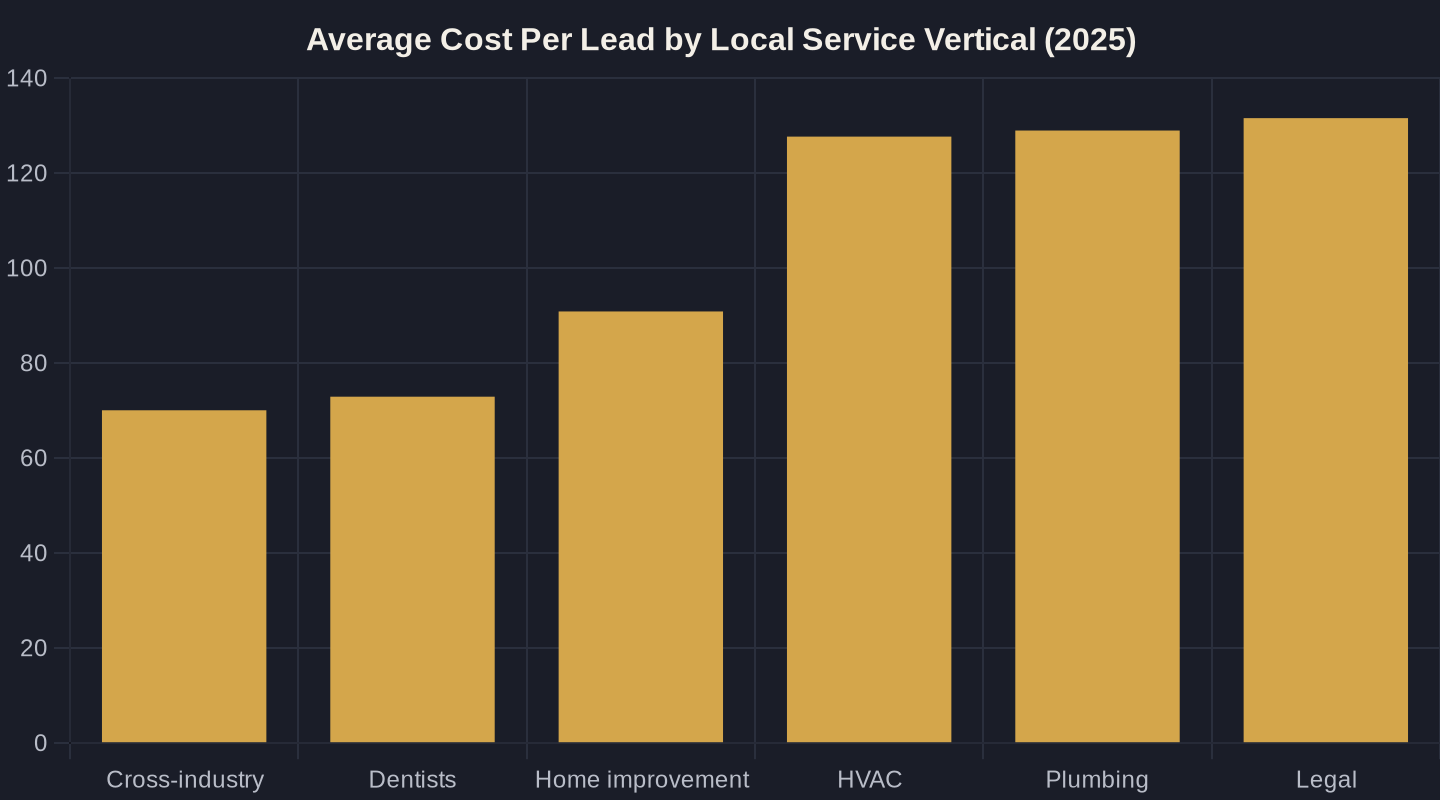
The averages hide enormous spread by vertical, and that spread is the whole game for a local owner. Attorneys and legal services averaged $9.87 per click and $131.63 per lead, home and home improvement ran $8.33 per click and $90.92 per lead, and dentists paid $8.00 per click and $72.97 per lead. A legal lead costs nearly double a dental lead, so the same budget that buys roughly 30 leads in one vertical buys 15 in another.
Size Your Google Ads Budget for Local Business to Your Vertical
This is where generic advice falls apart. If you run the trades, your costs are higher still. Plumbing averaged $10.49 per click and $129.02 per lead, and HVAC averaged $9.68 per click and $127.74 per lead, drawn from 3,211 U.S. home-services campaigns. At those costs, a $2,000 monthly budget buys roughly 15 leads before you account for the share that close.
So size the Google Ads budget for local business to the vertical first, then work backward. If a booked plumbing job is worth $600 and you close one lead in three, 15 leads is five jobs and $3,000 in revenue against $2,000 of spend. That single calculation tells you whether to spend more, hold, or fix your close rate before you add a dollar. Use the table below to anchor your own numbers against real cost-per-lead bands.
The Real Spend Distribution: What Local Businesses Actually Budget
It helps to see where you sit against live accounts before you commit a number. The average starting Google Ads budget for small businesses is $1,000 to $2,500 per month, roughly $20 to $50 a day. That is a reasonable on-ramp for a single-location local service business testing one or two tightly built campaigns.
Looking wider, across more than 15,000 accounts the average spend is $3,127.38 per month, with 39% spending between $1,000 and $10,000 and 24% spending under $1,000. In plain terms, a sensible Google Ads budget for local business at the start is four figures a month, not five, and you scale only when the leads convert at a cost you can defend. The chart below shows how lead cost climbs by vertical, which is the biggest reason two owners with the same budget see very different results.
| Vertical | Avg. cost per click | Avg. cost per lead | Est. leads/mo at $2,000 |
|---|---|---|---|
| Cross-industry average | $5.26 | $70.11 | ~29 |
| Dentists | $8.00 | $72.97 | ~27 |
| Home & home improvement | $8.33 | $90.92 | ~22 |
| HVAC | $9.68 | $127.74 | ~16 |
| Plumbing | $10.49 | $129.02 | ~15 |
| Attorneys & legal | $9.87 | $131.63 | ~15 |
Don't Forget the Phone: Calls Are Half the Math
For local service businesses, the form fill is only half the story. In home services, 37% of calls from digital marketing are leads, and 46% of those leads convert on the call, from Invoca's analysis of more than 60 million phone calls. If your budget math only counts web forms, you are undercounting results and almost certainly underspending.
That is why call tracking belongs in the budget, not bolted on later. It also shows which keywords drive the phone, so you can put spend behind intent that books. And because 71% of consumers use Google to find or read reviews of local businesses, the same buyer clicking your ad is checking your reputation in the next tab, so concentrate budget where they actually research and decide. For how the click-to-call path differs from Google's pay-per-lead product, see Local Services Ads vs Google Ads: Which Wins for Your Business?.
How to Set a Number You Can Defend
Here is the formula I give every owner. Start with what one new customer is worth over the first year, decide how many you can serve, and multiply by your cost per booked job (your cost per lead divided by your close rate). That total, not a percentage of revenue, is the floor for your Google Ads budget for local business. It scales with your capacity and your economics instead of someone else's spend.
- Cap waste early: tight keywords and aggressive negatives keep you off searches that never book. See Choosing (and Blocking) the Right Google Ads Keywords for Local.
- Protect the conversion: even a well-sized budget leaks if the click lands on a weak page. The Google Ads landing page that doubles your leads is where budget turns into booked work.
- Measure to revenue, not clicks: the whole point of Owner's Math is to know your return before you scale.
Set the number you can defend, then watch cost per booked job for 30 to 60 days before you touch it. If you want a second set of eyes on your spend, and a clear read on what a click is actually returning, book a call or join the newsletter, where I break down this exact math with real local accounts each week.
Sources
- WordStream: 2025 Google Ads Benchmarks (2025)
- LocaliQ: Search Advertising Benchmarks (by industry) (2026)
- LocaliQ: Home Services Search Advertising Benchmarks (2025)
- Invoca: Home Services Call Conversion Benchmarks Report 2025 (2025)
- BrightLocal: Local Consumer Review Survey (2026)
- WordStream: How Much Does Google Ads Cost? (2026)
Want this run on your numbers?
Book a call and we will run the Owner's Math on your business: clear numbers, a straight plan, no pitch. Or read the free Playbook first.