Customer Lifetime Value: What a Customer Is Really Worth
Most owners price their marketing against the first sale. Here is how to calculate what a customer is really worth over their whole lifetime, and why that number changes every budget decision you make.

Key takeaways
- Customer lifetime value is the total profit over the whole relationship, not the first sale. Measure it before you judge any ad as too expensive.
- The owner's formula is simple: average transaction x purchases per year x years retained, minus the cost to serve, plus referrals.
- New customers cost 5-25x more than keeping existing ones, and a 5% retention lift can raise profit 25-95%, so the back end is where the margin lives.
- Reputation starts the lifetime: 97% of consumers read reviews before the first booking, so your rating gates every future dollar.
- Budget by payback, not by first-invoice cost: set your acquisition ceiling at a fraction of lifetime value and fund the channels that repeat.
What Customer Lifetime Value for a Local Business Really Means
Customer lifetime value (CLV = the total profit a single customer produces over the entire time they do business with you) is not the first job, the first visit, or the first month. It is all of it. For a local service business, that number is almost always larger than the owner assumes, and seeing it correctly changes every marketing decision that follows.
Most owners judge their advertising against the first sale. That is the costly mistake. When you measure customer lifetime value for a local business properly, a lead that looks expensive on day one often turns out to be cheap across three years of repeat work and the referrals it brings. This is the core of Owner's Math: tracing what a dollar of marketing actually returns over time, not what it costs on the first click.
Think of it as the difference between a price tag and an investment return. A first job might net you $200. The same customer, kept for years and referring friends, might net you $5,000. Manage to the first number and marketing will always feel too expensive. Manage to the second, and you can confidently outspend competitors who only see the first sale.
How to Calculate It Without a Spreadsheet Headache
The owner's version of the formula is three numbers: average transaction value, how often a customer buys per year, and how many years they stay. Multiply the three, then subtract what it costs to serve them. That is your lifetime value, close enough to make decisions with, without a finance degree.
Work an example. A med spa at $300 a visit, four visits a year, for three years produces $3,600 before a single referral. An HVAC company at $450 a service call, roughly 1.5 calls a year, over six years clears $4,000. Suddenly a $120 cost to book that customer is not expensive, it is a bargain.
Two factors owners forget make the real number even bigger: referrals and reviews. A happy customer who sends one neighbor effectively doubles their own lifetime value at zero acquisition cost. Calculating customer lifetime value for a local business is not about precision to the penny. It is about getting the order of magnitude right so you stop starving the channels that actually pay back.

Why Acquisition Cost Only Makes Sense Against Lifetime Value
New customers are expensive. Research summarized in Harvard Business Review puts the cost of acquiring a customer at five to 25 times more than keeping one you already have. That gap is the entire economic case for measuring lifetime value before you judge any ad as too costly.
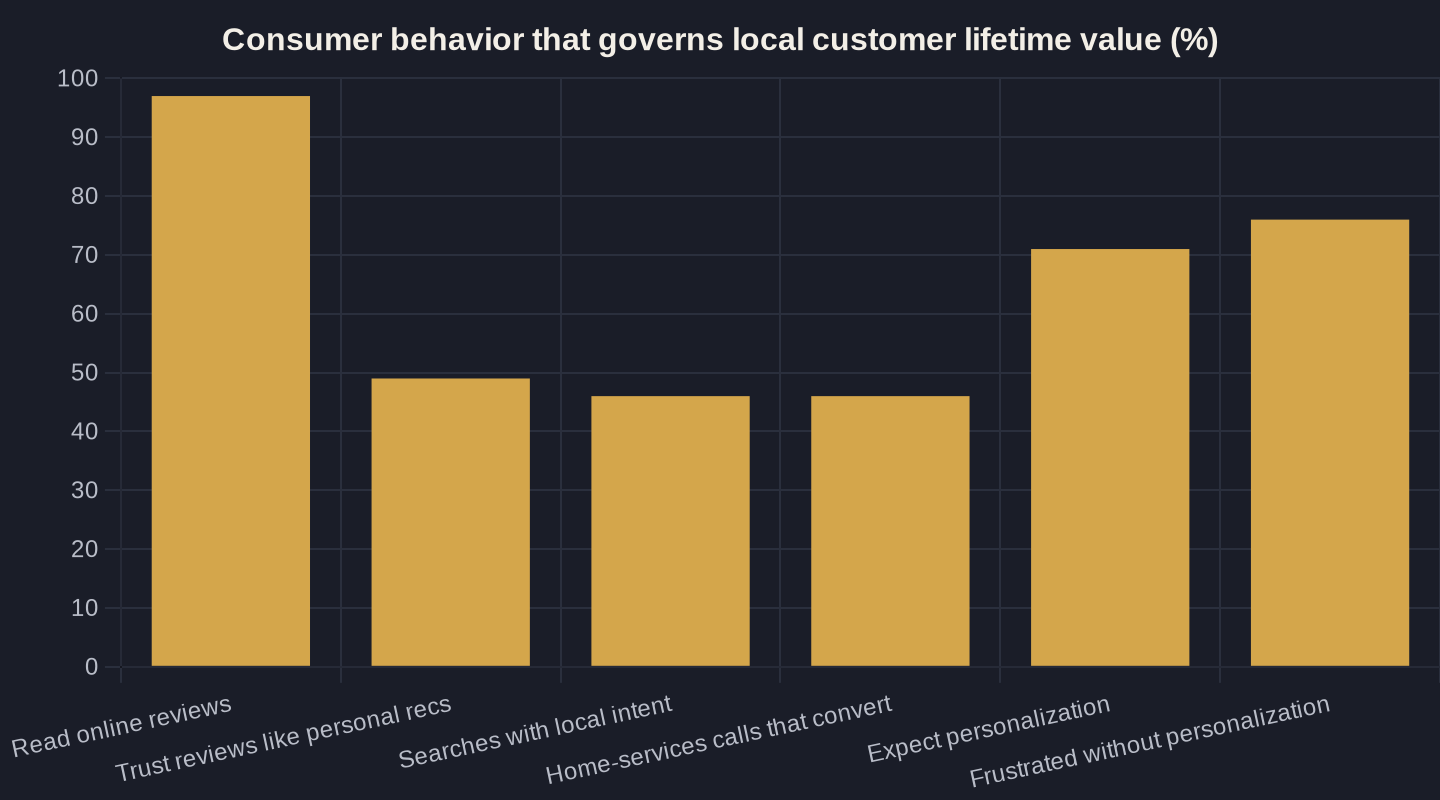
Local demand is genuine. Roughly 46% of all Google searches have local intent, meaning nearly half of search demand is people looking for a nearby business to buy from. But every one of those clicks carries a cost, and that cost is only justified against the full lifetime value of the customer it produces.
The phone is where much of that value is won or lost. Invoca's analysis of more than 60 million calls found 46% of inbound home-services phone leads convert on the call, which is exactly why how fast you answer decides whether an acquisition cost ever becomes a lifetime.
Retention Is Where the Profit Actually Lives
If acquisition is expensive, retention is where the margin hides. Frederick Reichheld of Bain & Company, the inventor of the Net Promoter Score, found that increasing customer retention rates by just 5% increases profits by 25% to 95%. Small retention gains compound into outsized lifetime profit.
One of the cheapest levers is treating people like you remember them. McKinsey reports that 71% of consumers expect personalized interactions and 76% get frustrated when they don't get them, with personalization most often driving a 10-15% revenue lift. For a local business that means a follow-up call, a service reminder, a name remembered, not an enterprise marketing platform.
This is why the customers you already have are your most underpriced growth asset. They cost nothing to reach, convert faster, and raise the lifetime value of your entire book of business.
| Business type | Avg transaction | Purchases / year | Years retained | Lifetime revenue |
|---|---|---|---|---|
| HVAC / plumbing | $450 | 1.5 | 6 | $4,050 |
| Med spa | $300 | 4 | 3 | $3,600 |
| Dental practice | $280 | 2 | 8 | $4,480 |
| Estate law firm | $2,500 | 1 | one matter | $2,500 + referrals |
| Landscaping | $180 | 8 | 4 | $5,760 |
Reputation Decides Whether the Lifetime Ever Starts
A customer's lifetime value is zero until they book the first time, and for local businesses, reputation governs that first booking. BrightLocal's consumer survey found 97% of people read online reviews for local businesses, and 49% trust those reviews as much as a personal recommendation.
That means your star rating and recent reviews are not vanity metrics. They are the gate every future dollar of lifetime value has to pass through. Two companies can spend the same on ads, and the one with a 4.8 and fresh reviews will convert more of that traffic into first jobs, and therefore more lifetimes.
The practical move is simple: ask every satisfied customer for a review while the job is fresh, and respond to the ones you already have. A steady drip of recent, specific reviews does more for new-customer conversion than most paid tactics, and it directly feeds the top of your lifetime-value funnel.
Putting Customer Lifetime Value to Work
Knowing the number is useless until it changes what you do. Set a target cost per acquired customer at a fraction of lifetime value. Many local operators aim to recover acquisition cost inside the first job or two, then bank the rest of the lifetime as profit. That single rule tells you which campaigns to fund and which to cut.
- Set your acquisition ceiling. Decide the most you will pay to book a customer, a fraction of their lifetime value, not their first invoice.
- Fund by payback, not by cost. A pricey channel that pays back inside two jobs beats a cheap one that never repeats.
- Protect the back end. Reminders, follow-ups, and reviews raise retention, and a 5% lift compounds into real profit.
It also exposes waste. Most owners cannot say which marketing produced which customer, and that blind spot, the attribution gap, makes them defund their best channels by accident. Pair lifetime value with honest tracking, then close the obvious drains documented in where local businesses waste ad spend. Used this way, customer lifetime value for a local business stops being a textbook term and becomes the number that governs your budget. It is the spine of the full Marketing ROI for Local Business: The Owner's Math Guide.
Start With the Number Before the Next Dollar
Before you approve another ad budget, write down what one new customer is worth to you over their lifetime. Most owners have never done it, and the number reframes everything: what a lead is allowed to cost, which channels deserve more, and how much a lost customer truly costs.
If you want help building that number for your business, and tracing it from the first impression to repeat revenue, that is the work I do. Book a call, or subscribe to the newsletter, where I break down one piece of Owner's Math each week in plain English.
Sources
- Harvard Business Review: The Value of Keeping the Right Customers (Amy Gallo) (2014)
- Harvard Business Review / Bain & Company (Frederick Reichheld) (2014)
- BrightLocal: Local Consumer Review Survey (2026)
- Invoca: Home Services Call Conversion Benchmarks Report (2025)
- McKinsey & Company: The value of getting personalization right (or wrong) is multiplying (2021)
- BrightLocal: Local SEO Statistics (citing Google) (2018)
Want this run on your numbers?
Book a call and we will run the Owner's Math on your business: clear numbers, a straight plan, no pitch. Or read the free Playbook first.